Is Cursive Still Important?
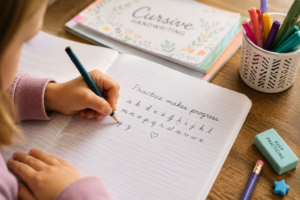
With so much of today’s world happening on screens, many parents wonder if learning cursive is still important.
After all, students type more than ever before. Some schools spend very little time teaching cursive—or skip it altogether. So it’s understandable when parents ask:
“Does cursive still matter?”
Research increasingly suggests that it does, and as a practitioner who daily works with dyslexic students, I fully agree.
And not just because children may someday need to read old documents or sign their names.
What Research Says About Handwriting and the Brain
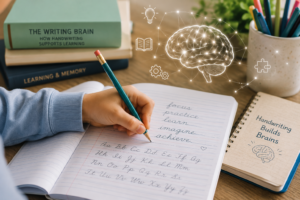
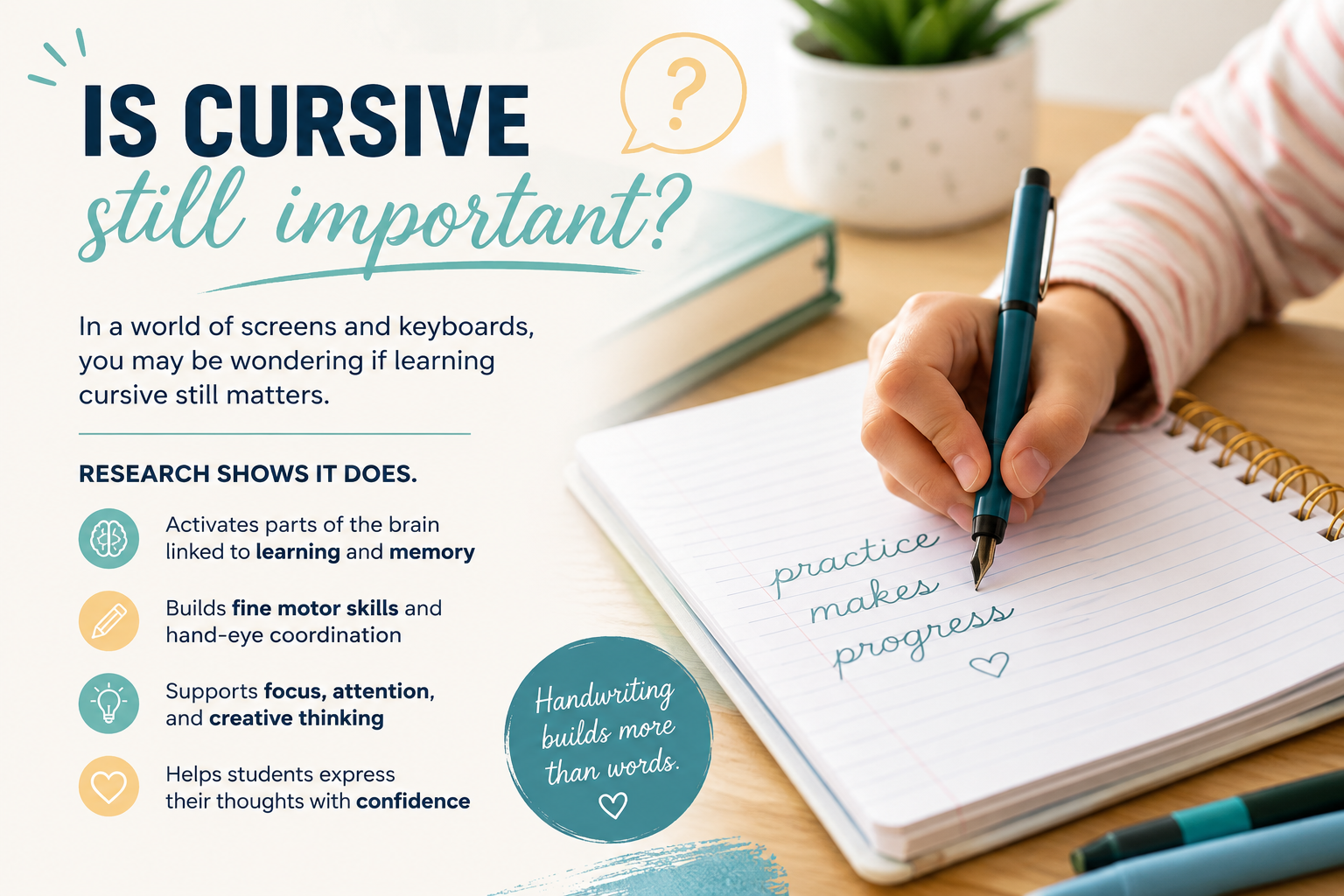
The act of writing by hand actually activates parts of the brain connected to memory, language, learning, and fine motor development in ways typing does not. Studies have found that handwriting helps strengthen neural connections and supports memory and recall.
When students write by hand, the brain is working differently than when pressing keys on a keyboard. Writing requires coordination between visual processing, motor planning, memory, and language systems. Researchers have even found increased brain activity connected to learning and memory during handwriting tasks.
Cursive adds another layer because the connected flow of letters encourages fluid movement patterns and continuous motor planning. Some research suggests this can support writing fluency, memory, attention, and fine motor coordination.
Of course, keyboarding is an important skill too. This isn’t about choosing one or the other.
Students benefit from both in today’s world. But for younger learners especially, the focus should first be on building strong brain connections through handwriting. Writing by hand actively engages multiple areas of the brain involved in learning, memory, language, and motor development in ways typing simply does not.
There is tremendous value in slowing down, putting pencil to paper, and actively engaging the brain through handwriting.
Cursive and Students With Learning Struggles
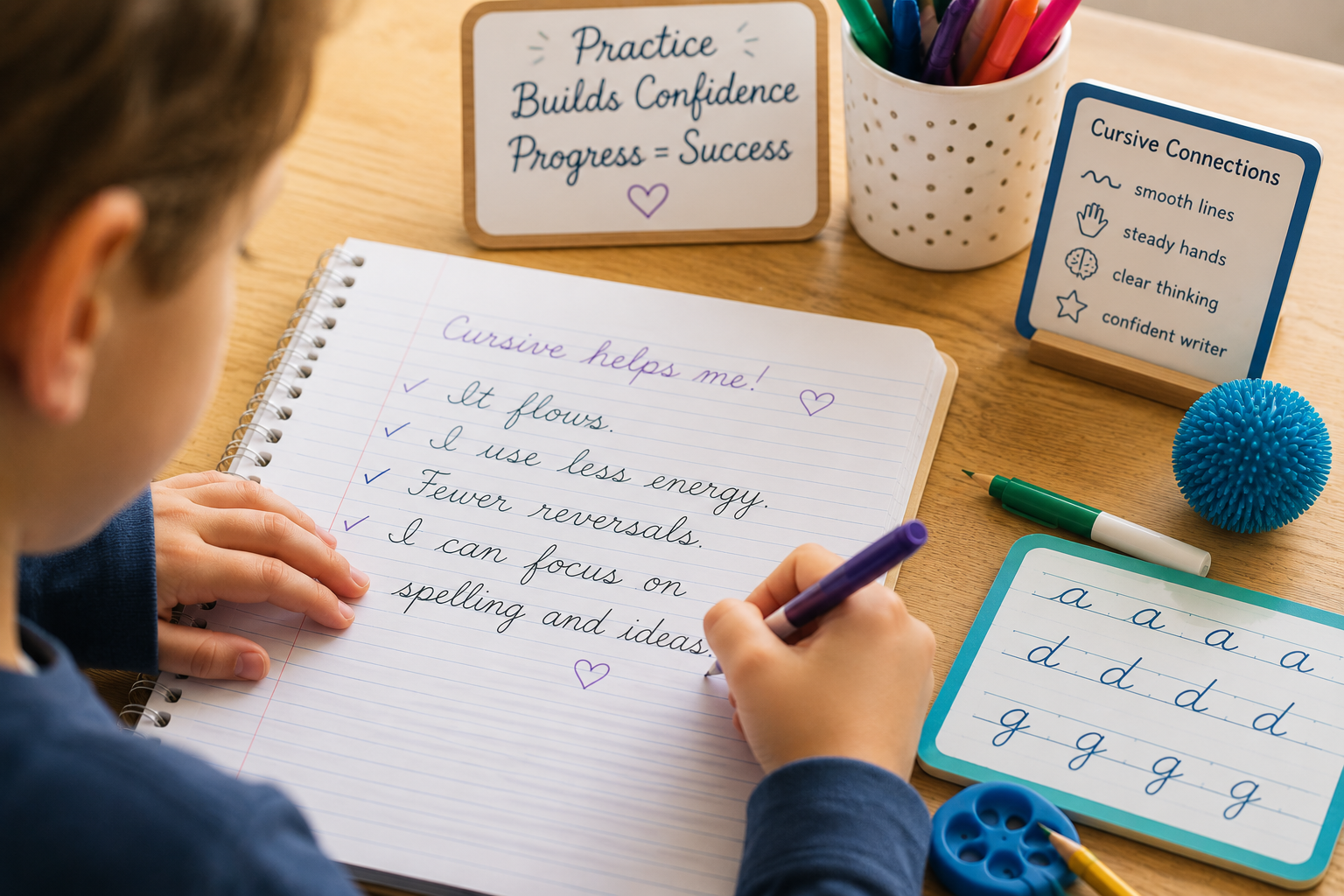
As a Dyslexia Practitioner, I have also seen that some students with learning struggles actually find cursive easier once learned because the writing becomes more fluid and automatic.
Less mental energy has to go into forming individual letters, there are often fewer reversals, and more attention can be focused on spelling, sentence creation, and getting ideas onto paper.
I also often see that students enjoy learning cursive because it feels different, creative, and hands-on. For many children, it can build confidence and motivation around writing in a new way.
Why Handwriting Still Matters
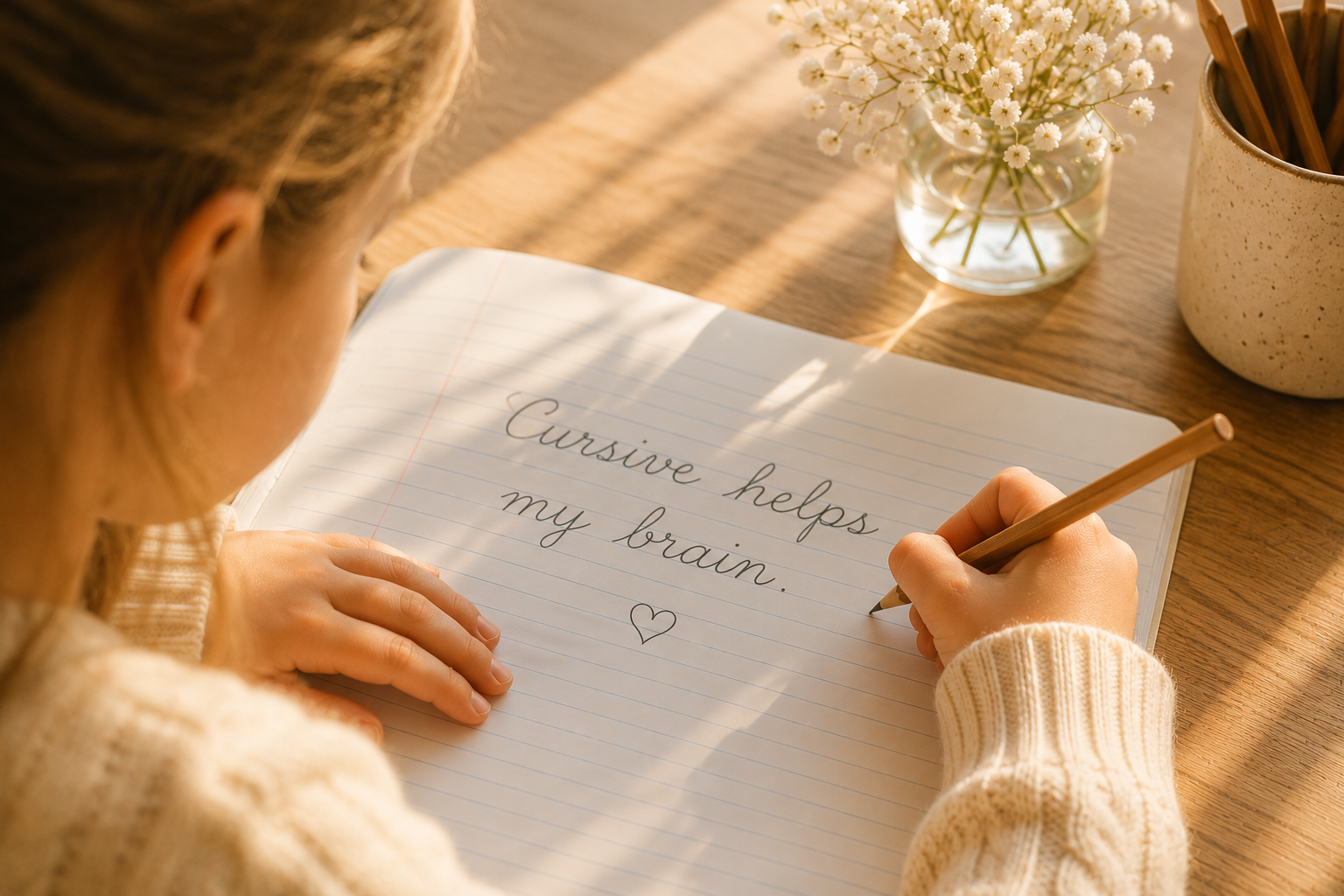
Whether your child learns cursive through school, home practice, or summer enrichment opportunities, handwriting is still a valuable skill that supports the brain, learning, communication, and confidence.
And sometimes, slowing down and putting pencil to paper is exactly what kids (or all of us) need in a fast-paced digital world.
How My Online Cursive Camp Works
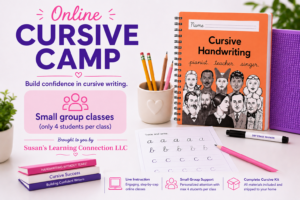
That’s one reason I’m excited to offer small-group ONLINE Cursive Camp this summer through Susan’s Learning Connection LLC.
Students receive a cursive kit mailed directly to their home, and lessons are multisensory and hands-on. While we meet online, students are actively learning and practicing using real materials—not simply watching a screen.
You can learn more about current camp sessions here: Cursive Camp Information
Helpful Cursive Resources
If your child is interested in practicing cursive at home, here are a few helpful resources to explore:
Learning Without Tears — Research-based handwriting curriculum and resources with multisensory activities, printables, and parent support materials.
K5 Learning Free Cursive Worksheets — Free printable cursive worksheets for letters, words, and sentences. Great for extra practice at home.
MyCursive Free Resources & Worksheet Generator — Offers free printable worksheets, handwriting tips, and a customizable worksheet generator for extra practice.
Research & Resources
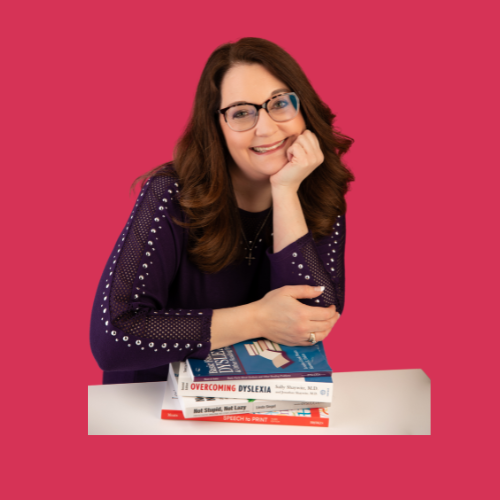
Hi! Thanks for being here. I’m Susan, a Certified Dyslexia Practitioner helping overwhelmed parents make sense of dyslexia, take the next clear step, and supporting students through Orton Gillingham reading intervention.
Susan Clabaugh (A/OGA, CALP/ALTA, MAT)
© 2026 Susan Clabaugh. All rights reserved. Please do not copy or redistribute this content without written permission.
All content is provided for educational purposes only. I am not an attorney, and nothing on this site should be considered legal advice. Susan Clabaugh & Susan’s Learning Connection LLC are not responsible for any outcomes related to the nonuse, use, or application of this material.